

Infrared Thermography Inspection Miami — Level III Electrical Thermal Imaging - P.E.-Sealed.
P.E. #67462 · Level III CIT® #19397 · Firm #28738 · Miami · 41 Years.
Updated August 12, 2026.
★★★★★ 5.0 on Google · Serving South Florida.
Hablamos Español.
What Is a Miami Electrical Infrared Thermography Inspection, and How Does It Work?
An infrared electrical thermography inspection reads the heat each connection emits, finding the failing lug, breaker, or feeder early. All Home Meters scans energized and under load; every finding is temperature-graded and photographed in the report.
Real Infrared Findings.
Sealed report pages from our infrared scans, three severity levels — details redacted. Every sealed inspection report carries.
- Level III certificate.
- Digitally notarized signature of a Professional Engineer.
- Equipment summary lists — labels, nameplate data, location, date and time — with exclusion reasons.
- Statement that every required piece was covered.
- Camera specs.
- One consistent palette across the report.
- Measurement determinations.
- Environmental and load data.
- Temperature scales.
- Paired photos, with and without covers.
- Causes and priorities.
- Code violations and anomalies.
- Grounding system scan.
View a Sample Thermal Report (PDF).
Developing / Alert.
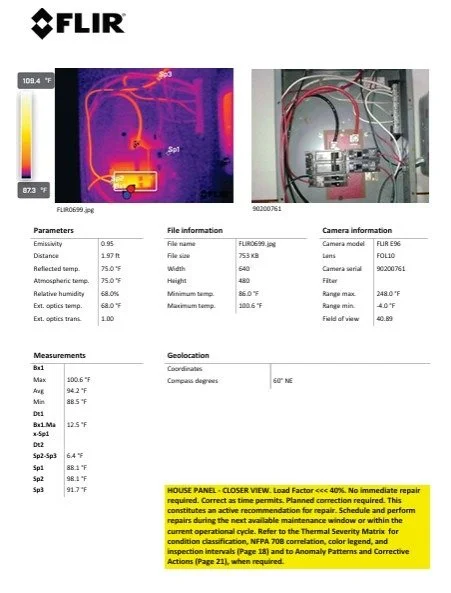
A service panel flagged during the thermal imaging inspection on a ΔT2 of 6.4°F between similar components. Planned correction; no immediate repair.
Serious / Severe.
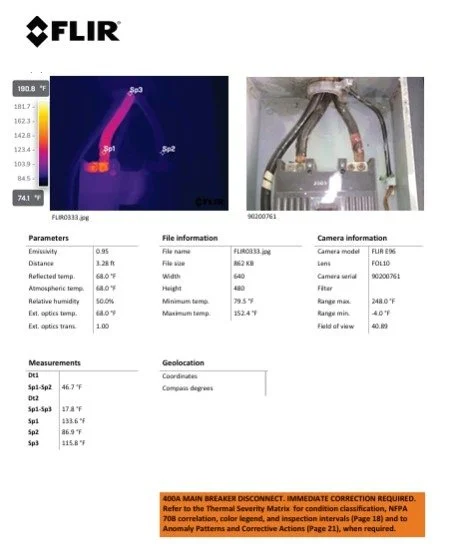
A 400A main breaker disconnect flagged in the thermal inspection at a ΔT1 of 46.7°F above reference. Urgent correction required.
Critical / Major.
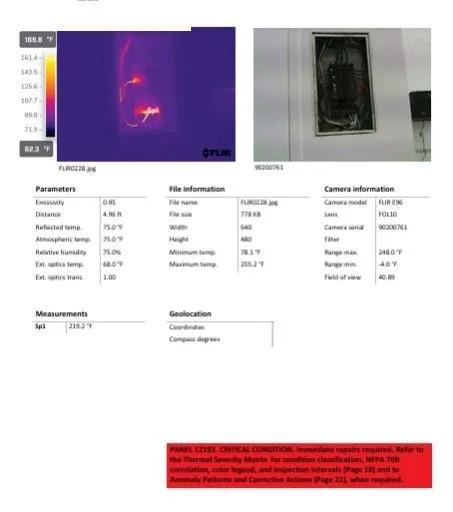
Thermal imaging of a panel reaching 219°F, exceeding the maximum allowable temperature. Emergency correction; do not defer.
What Does the Electrical Infrared Thermal Imaging Inspection Detect?
Loose connections, overloaded circuits, phase imbalance, failing breakers, hidden moisture — defects a thermographic inspection finds and a visual inspection cannot. Every anomaly in the thermal imaging inspection is temperature-graded against three criteria — ambient operating temperature, a component under the same load and of the same material (or the same component when none is available), and the temperature the NEC allows — with its corrective action.
What Does Dade County Require for the Electrical Infrared Scan?
The County requires the thermal inspection of every service at 400 amperes or greater as part of the 40 year recertification, by a Level II or higher certified thermographer under the BORA guidelines revised November 18, 2021. The engineer of record states the thermal inspection results and signs the entire report. The scan covers the electrical equipment BORA lists — busways, switchgear, panelboards (except dwelling-unit load centers), disconnects, VFDs, starters, control panels, timers, meter centers, gutters, junction boxes, transfer switches, exhaust fans, and transformers. No equipment list? Our survey identifies everything BORA requires.
When Is a Thermography Scan Mandatory?
For the Miami-Dade County recertification at 400 amperes or larger; under NFPA 70B annual infrared scans are required; and insurers request a thermal imaging inspection report at renewal.
How Much Does an Electrical Infrared Inspection Cost?
The infrared scan starts at $900 for services of 400 amperes and up; cover removal starts at $250. When a reinspection is required, it starts at $750 and covers only the faults we flagged. Send the address for a same-day fixed quote on the thermography inspection.
Why Property Owners Choose Us for Thermography.
One professional is both the Florida P.E. of record and the Level III Infrared Thermographer, so findings and seal carry a single signature. Some cities reject thermographers without an electrical license, because for them it is the only way to prove five years of experience inspecting commercial electrical systems — ours is backed by one. Electrical thermal imaging inspection reports accepted by officials and insurers. 5.0 on Google. Call (786) 318-7203.
Frequently Asked Questions.
What is an infrared scan?
A non-contact inspection reading the surface temperature of electrical systems, revealing overheating connections, hidden moisture, and missing insulation.
Is the scan mandatory for my building?
For a 40 year building recertification inspection in Miami, Beach, Hialeah, Homestead, or Doral, yes at 400 amperes or greater. NFPA 70B also requires annual infrared inspection on commercial electrical equipment, and many insurers ask for one at renewal. The statewide Milestone Inspection is structural and does not itself require the electrical scan.
Does my individual panel have to be 400 amps?
No — the trigger is the service rating: at 400 amperes or greater, the equipment it supplies is in scope even when a panel is below 400A.
How much does it cost?
Infrared scans start at $900 — the fee depends on residential or commercial units, equipment count, and configuration; cover removal starts at $250. Send your address and likely electrical component count for a fixed written quote.
Are your reports accepted by insurers?
Each finding carries the infrared frame, matched photo, emissivity, ΔT value, NFPA 70B class, and P.E.-sealed recommendations — the format insurance carriers require.
Our Services.
- 40 Year Recertification.
- Level III Infrared Thermographer.
- Electrical Safety Inspection.
- Photometric Inspection.
- Structural Inspection.
- Milestone Inspection.
- NFPA 70B Electrical Maintenance Program.
- Equipotential Bonding & Ground Resistance Test.
- Certificate of Use (CU).
Credentials.
- Florida Professional Engineer — P.E. #67462; every report sealed.
- Level III Certified Infrared Thermographer — Infraspection CIT® #19397; aligned to ASNT SNT-TC-1A & ISO 18436-7 Category III; 4,500+ hours.
- FLIR E96, 640 × 480; NIST-traceable, verified 12/09/2025.
- Certification letter with every package; signature digitally notarized by IdenTrust.
- HUD Inspector #S262 · FHA Consultant #A0783.
About the Engineer.
Armando Longueira, P.E. #67462, licensed since 2007, earned his electrical engineering degree in 1985, holds 4,500+ infrared thermography hours, and is a Level III thermographer (CIT® #19397). He owns All Home Meters (Firm #28738) — sealing every thermography scan; verify #67462 on the DBPR roster.
Service Area.
We perform condominium, commercial, HOA, and industrial building electrical thermographic inspections. We cover Miami-Dade, including the City of Miami, Miami Beach, Hialeah, Doral, Homestead, and Coral Gables, returning sealed infrared reports within three to five business days. We schedule thermal imaging Miami-wide.
Schedule a Thermography Scan.
Catch the electrical fault with a thermographic inspection before it becomes a fire or a denied claim.
Call or text (786) 318-7203 with your address and likely electrical component count for a fixed written thermal inspection quote the same day.
Related. 40 Year Recertification · Electrical Inspection · Structural Inspection · Parking-Lot Illumination · NFPA 70B Program · Español.