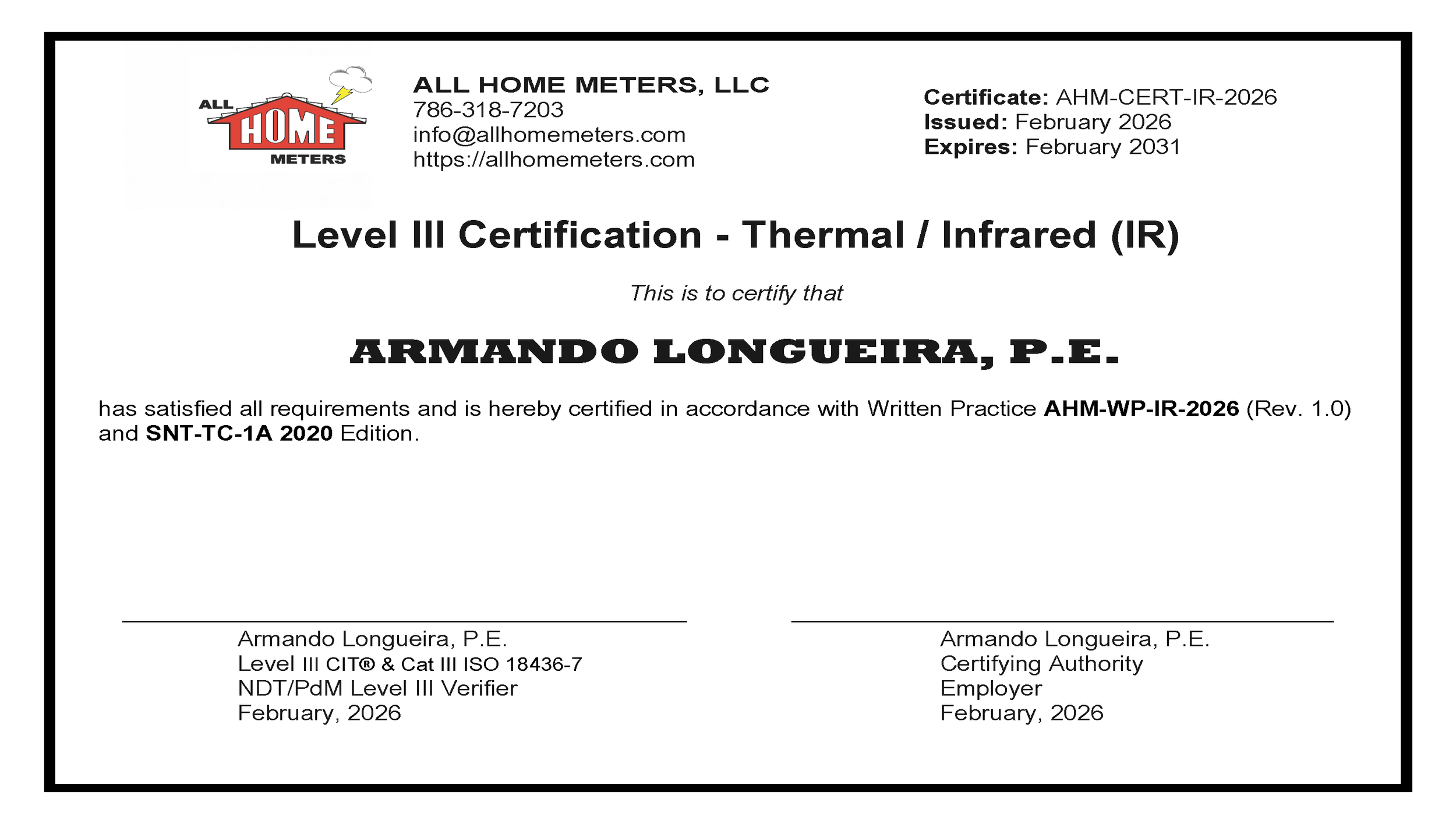
Infrared Thermographer Miami - Level III /Cat III
Electrical Infrared Thermography Inspection Report - AHM-IR-R-2026
TECHNICAL & ADMINISTRATIVE SUMMARY
The following specifications reflect the qualifications, equipment standards, and administrative procedures governing the infrared thermography inspection program.
“Professional-Grade” Infrared Thermography Inspection Parameters
· Detector Resolution: Minimum of 320 × 240 pixels (Recommended Industry Benchmark).
· Focus: Manual Precision Focus capability (Best Practice).
· Spatial Resolution (IFOV): Maximum of 1.5 mrad (Industry Benchmark).
· Thermal Sensitivity (NETD): Maximum of 50 mK (Common Professional Benchmark).
· Parameter Control: Adjustable emissivity and reflected apparent temperature compensation, with all parameters documented in the inspection report.
General Report Standards
· NIST-Traceable Calibration: Annual laboratory calibration of the infrared imager traceable to national standards, ensuring measurement accuracy and legal reliability.
· Visual Examinations: Validated near-vision acuity, color perception, and grayscale contrast sensitivity examinations.
· Technical Documentation: Comprehensive recording of environmental variables and circuit loading conditions, alongside all relevant camera parameters.
· Measurement Criteria: Quantitative evaluation utilizing Temperature Differential (Delta T), load ratio, and phase current measurements.
International Organization for Standardization (ISO) 18436-7 (Categories)
· SOP Development: Documented procedure for infrared thermography established and approved by Category III Personnel.
· Operational Limits: Category III Personnel responsible for the technical program. Category I and II Personnel operate strictly within the scope of their competence.
· Certification Cycle: Personnel certification renewal occurs at intervals not exceeding five (5) years.
American Society for Nondestructive Testing (ASNT) SNT-TC-1A (Levels)
· Written Practice (WP): Established guidelines for the Qualification and Certification of Personnel for Employer-Based Certification.
· Standard Operating Procedure (SOP): Detailed, written, step-by-step instructions for field execution.
· Supervision: Oversight provided by a Responsible Level III NDT/PdM Technical Authority.
· Certification Requirements: Rigorous written, practical, and specific examinations—including documented field experience—extending beyond training certificates alone.
· Authority & Review: The Employer remains the sole entity authorized to certify Personnel under the guidance and approval of the Responsible Level III NDT/PdM.
· Recertification: Personnel certification renewal occurs at intervals not exceeding five (5) years.